
Al Pacino
Al Pacino
Three characters. Three completely different men. One actor who made every single one of them feel inevitable. Al Pacino across twenty years of cinema is a graduate school in masculine presence — and the wardrobe that came with it is still worth studying today.
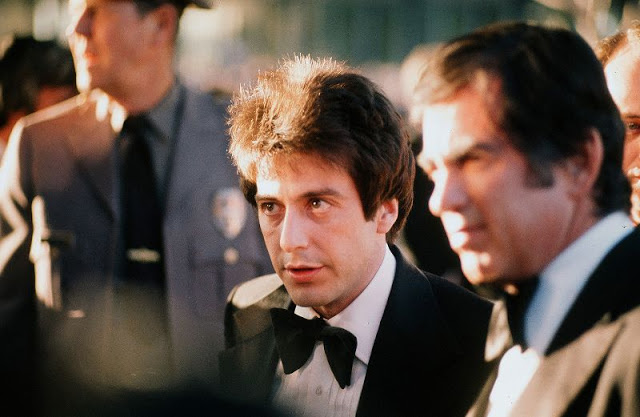
Born in East Harlem in 1940, Al Pacino arrived in Hollywood carrying something far more difficult to categorise than conventional leading-man quality — a coiled, restless intensity that made every scene he appeared in feel as though something was about to happen. That quality, combined with a commitment to character so total it bordered on frightening, produced three of the most iconic performances in the history of American cinema. And three very different wardrobes worth understanding.
Michael Corleone is one of the great style arcs in cinema. Watch the three Godfather films in sequence and you are watching a man’s wardrobe chart his transformation — from the clean, understated Ivy League suits of a returning war hero who wants nothing to do with the family business, to the dark, heavy Italian tailoring of a man who has become the most powerful figure in the room.
In the first film, Michael’s suits are slim, restrained, and collegiate — soft shoulders, narrow lapels, quiet colours. By the second film, the silhouette has widened, the cloth has darkened, and the man inside has hardened to match. The transformation is entirely visible in what he wears, which is exactly the point. Pay attention to the collar of his shirts throughout — always buttoned, always precise, always the last thing a man checks before he walks into a room he intends to control.


Tony Montana is the other extreme — maximalist, theatrical, and deliberately excessive. The white linen suits, the open-collar shirts, the gold chains, the floor-to-ceiling excess of the Montana mansion. Brian De Palma and costume designer Patricia Norris built Montana’s wardrobe as a portrait of a man who has acquired everything and understood none of it — wealth worn as armour by someone who had never been taught the difference between power and its performance.
The lesson for the young gentleman is the study itself. Montana’s wardrobe is a precise portrait of what happens when a man confuses wealth with taste and volume with power. Loud clothes on an insecure man are a confession. Quiet clothes on a confident man are a statement. Montana is a study in the difference, and the contrast with Michael Corleone in the same actor’s filmography is one of the great wardrobe lessons in cinema.

“Quiet clothes on a confident man are a statement. Montana is a study in the difference.”
Frank Slade is where Pacino’s style legacy reaches its most sophisticated point. Lieutenant Colonel Frank Slade, blind and irascible, checking into the Pierre Hotel in New York for one last weekend of deliberate living, wearing a Glenurquhart check three-piece suit made by tailor Martin Greenfield — high-waisted pleated trousers, a five-button waistcoat with a distinctive lapel, double-cuffed shirt from Turnbull & Asser. The suit is a masterclass in old-world American tailoring executed with military precision.
What makes Slade’s wardrobe so instructive is that he is a blind man who dresses better than anyone around him — because he learned what good clothes felt like long before he lost the ability to see them. He dressed by feel, by memory, by standard. That is the purest expression of genuine style: when you no longer need external validation to know you are dressed correctly.


Away from cameras, Pacino was New York through and through — dark overcoats, black turtlenecks, leather jackets worn with jeans and boots. He dressed like a man from the neighbourhood who had made it without forgetting where he came from. The intensity that he brought to every character translated off-screen into a presence that needed no assistance from clothing. He simply showed up, and the room adjusted.
Study the arc. Michael Corleone tells you how to dress with restrained authority — slim, dark, controlled. Frank Slade tells you that genuine style is internal, built on standard rather than on sight. And Tony Montana tells you exactly what the alternative looks like.
The Pacino lesson is ultimately about commitment. Every character he played was completely inhabited — the clothes, the posture, the pauses, the silences. A man who carries himself with that kind of total conviction commands every room he enters. The wardrobe follows naturally. It always does.
The Gentleman Who Wants
the Full Picture
Knows where to find it. Subscribe to MGA Premium and step inside the complete archive — every Icon, every review, every editorial, in full.
Become an MGA Premium MemberEditorial commentary reflects the independent analysis of Modern Gentleman Archive. All factual reporting is drawn from cited third-party sources. MGA makes no claim of ownership over source material.