
The Nine Machines Every Gentleman Should Know by Heart
The Nine Machines Every Gentleman Should Know by Heart
The machines from the golden age of the grand tourer that belong in a gentleman’s permanent education — by name, by sound, and by heart.

In September 1963, Aston Martin unveiled a car at the Frankfurt Motor Show that managed to be two things at once: the finest expression of the British grand tourer, and the most famous automobile in cinema history. The DB5 was built at the company’s Newport Pagnell factory in Buckinghamshire, clothed in a body designed by Federico Formenti at Carrozzeria Touring Superleggera in Milan, and powered by a 4.0-litre twin-cam straight-six producing 282 bhp. Production ran from 1963 to 1965, with just 1,059 units built in total — 887 saloons, 123 convertibles, and a small number of bespoke shooting brakes.
The DB5 was never the fastest car of its era, nor the most powerful, nor the most technically advanced. It was something more difficult to engineer than any of those things: it was the right car, at the right moment, with the right face. When Sean Connery drove one in Goldfinger in 1964, the car stopped being a low-volume British sports car and became a cultural standard — the answer to which every subsequent grand tourer of the decade was implicitly compared.
This is the story of the cars that competed with it.

The DB5 was never the fastest car of its era, nor the most powerful. It was the right car at the right moment with the right face. What it possessed was composure — the rare quality of a car that appears to require no validation from the outside world. Every rival on this list was, in some way, making an argument. The DB5 was simply making a statement.
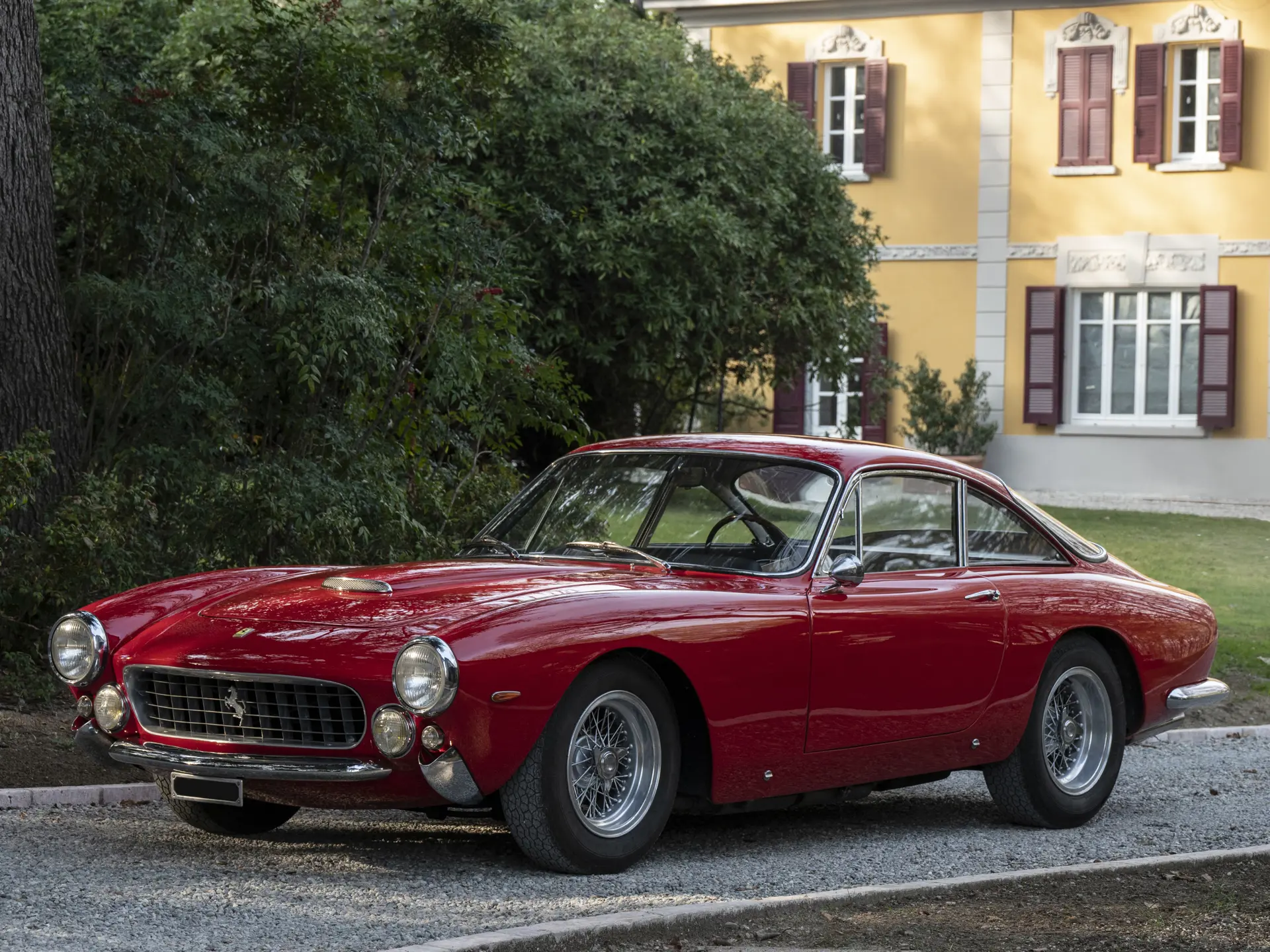
The Lusso debuted at the 1962 Paris Motor Show, bodied by Scaglietti to designs by Pininfarina, and went into production until mid-1964 with 350 cars produced. Its 3.0-litre Colombo V12, fed by three Weber carburettors, produced 240 bhp through a four-speed gearbox. Where the DB5 was a gentleman’s car with a sportsman’s engine, the Lusso was a sportsman’s car with a gentleman’s interior. Steve McQueen and Eric Clapton each owned one — which tells you precisely the kind of man it attracted and precisely how seriously the car earned that attraction.
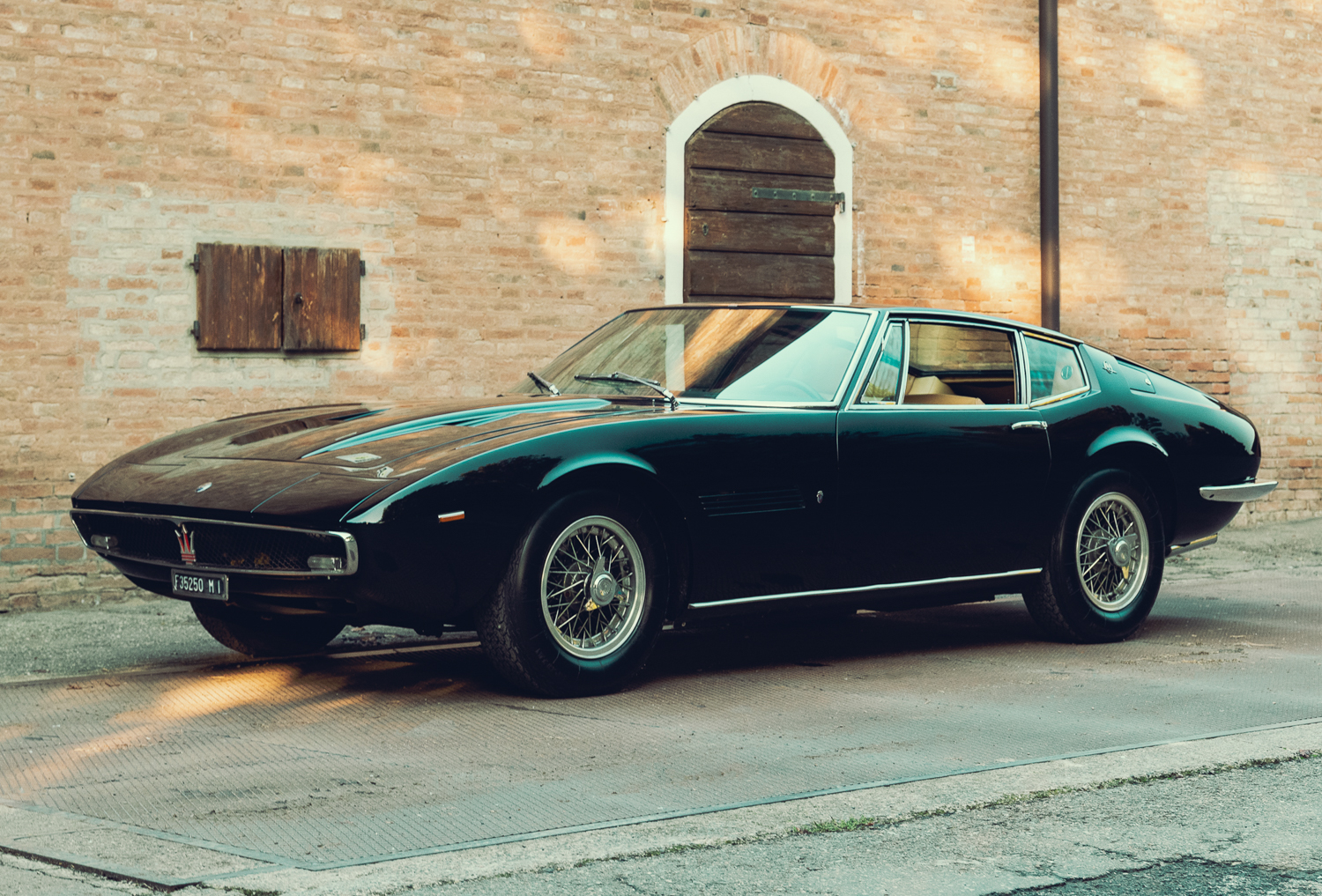
Designed by Giorgetto Giugiaro, the Ghibli arrived four years after the DB5 and operated from a different philosophy entirely. Powered by a quad-cam 4.7-litre V8 producing 310 PS, it was low-slung, aggressive, and futuristic in a way the Aston was deliberately not. Despite being the most expensive of its immediate rivals, the Ghibli outsold both Ferrari and Lamborghini in its class. Its interior was defined above all by the quality and quantity of its leather — a car that understood that for the man spending this kind of money, what surrounds him matters as much as what moves him.

Ferruccio Lamborghini set out to build a better car than Ferrari after an unsatisfying encounter at Maranello — and the 400 GT, designed by Carrozzeria Touring and powered by a 3.9-litre quad-cam V12 producing 320 bhp through a five-speed gearbox, came remarkably close. The first Lamborghini to offer genuine 2+2 accommodation, it was aimed directly at the same customer who might otherwise write a cheque for an Aston Martin. What it lacked was the DB5’s cultural halo — and that, as every subsequent decade confirmed, was worth considerably more than the mechanical advantage.

The E-Type cost a fraction of anything Ferrari, Maserati, or Aston Martin had in their lineup and yet offered a specification unmatched by any of those more expensive rivals. Enzo Ferrari called it — depending on which account you prefer — the most beautiful car ever made. The E-Type and the DB5 addressed the same moment in British motoring from entirely different positions. The Jaguar was a spectacle, theatrical and priced for accessibility. The Aston was a private statement for a man who required no audience. By the time Series 1 production ended, nearly 15,500 had been completed. Aston Martin produced just over a thousand DB5s across the same period. Both figures tell you exactly what each car was.
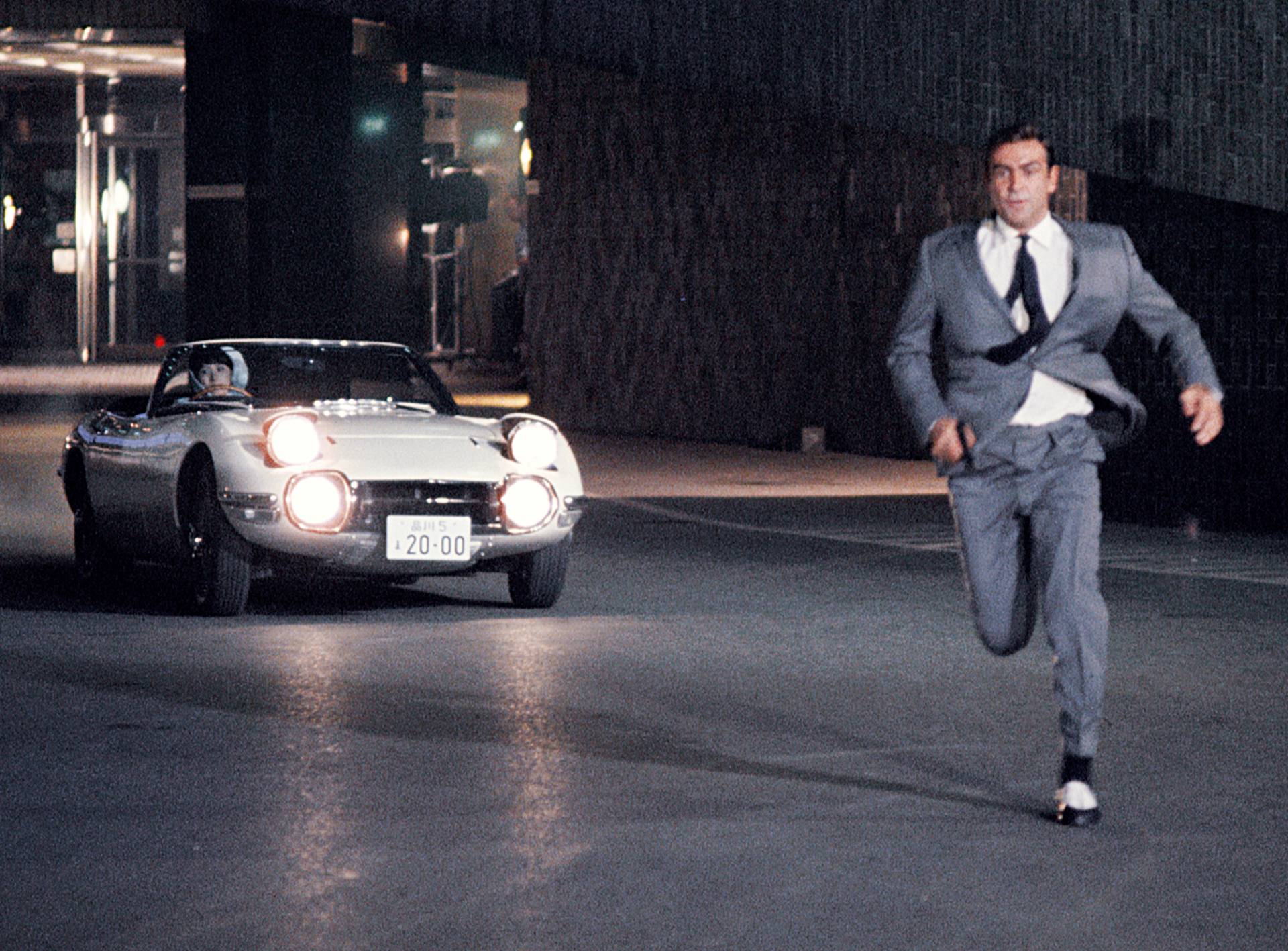
A joint project between Toyota and Yamaha, with just 351 produced. Japan’s statement that the grand tourer was not an exclusively European form — and it made that statement with extraordinary precision. The 2000GT was so aesthetically coherent, so clearly the product of serious study, that it became a Bond car itself, operating on the DB5’s own cultural territory in You Only Live Twice. What it proved was something more significant than its performance figures: that the language of the grand tourer was translatable, and that a manufacturer with the discipline to study it carefully enough could produce something worth comparing to the originals.
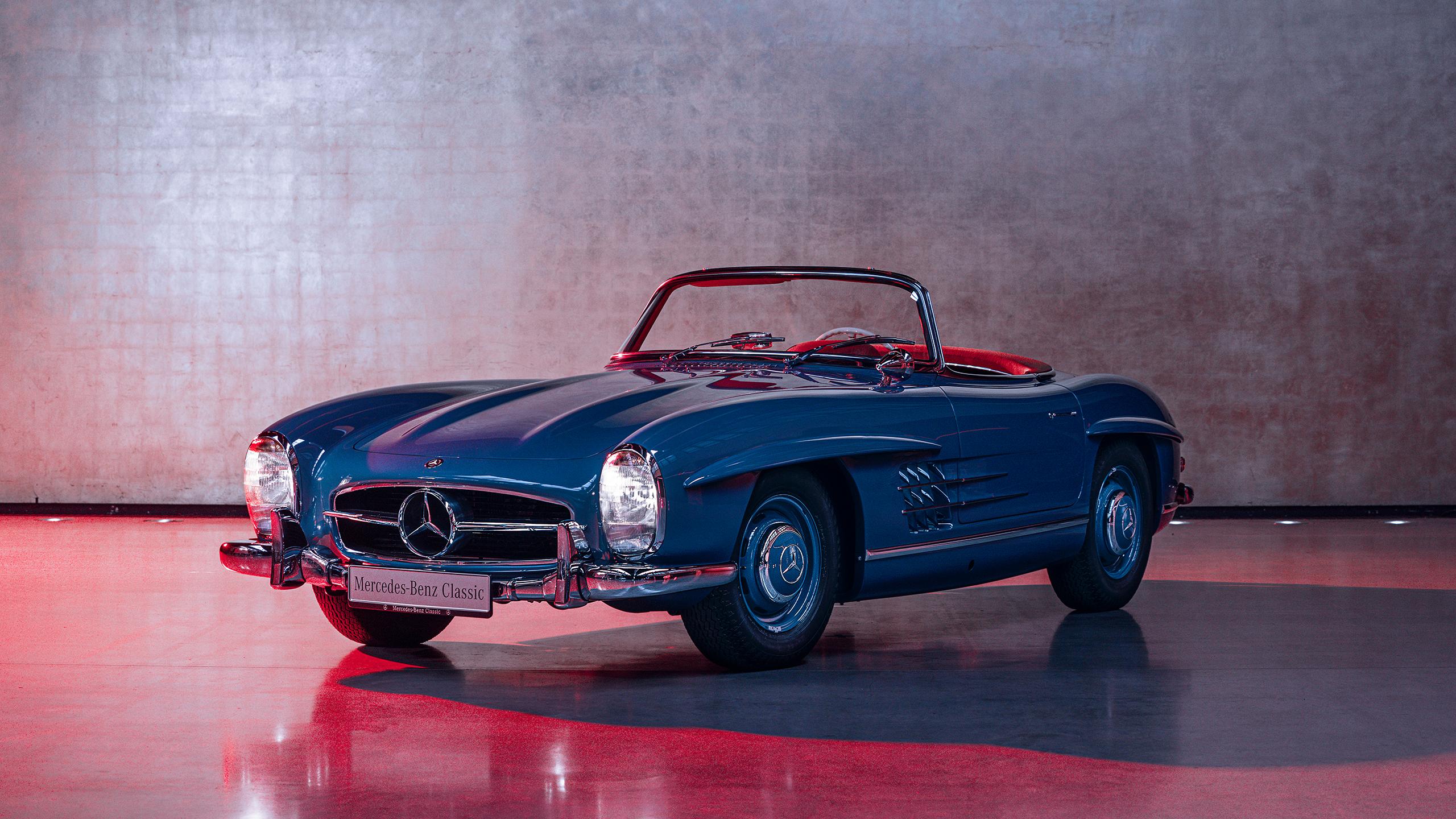
The 300SL occupied the generation immediately preceding the DB5 and established the technical and aesthetic standard against which the grand tourers of the 1960s were measured. The Gullwing coupé had made the name legendary; the Roadster refined the proposition into something more liveable without sacrificing the drama. As a direct contemporary it overlapped the DB5’s first year by a matter of months — which makes the comparison not quite parallel, but the 300SL’s presence sat over every serious grand tourer that came after it, including the one from Newport Pagnell.
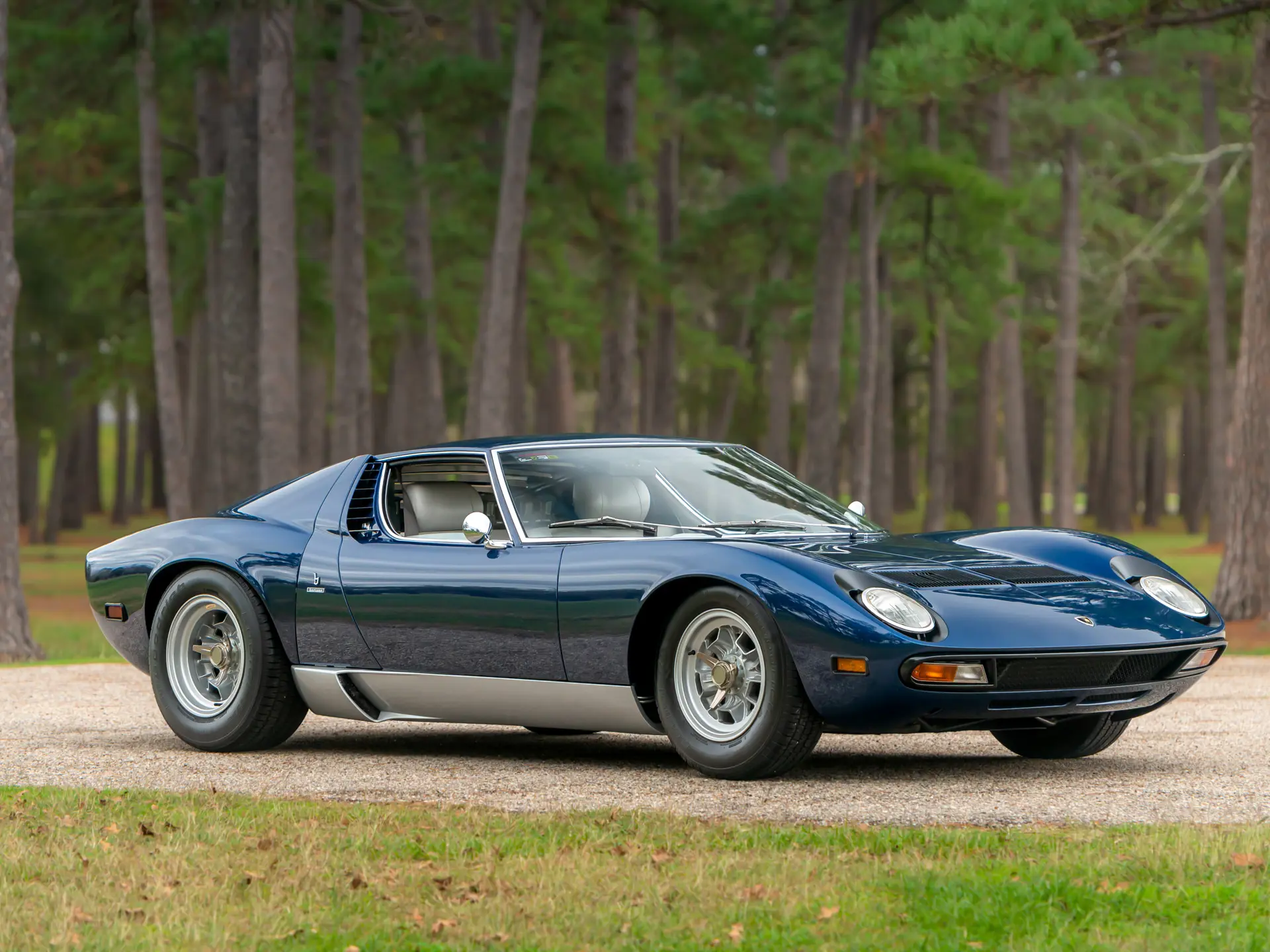
The Miura changed everything. Designed by Marcello Gandini at Bertone and unveiled at the 1966 Geneva Motor Show, it was the first production car to mount its V12 transversely in a mid-engine position — a layout that every serious supercar has followed ever since. At its US introduction in 1967 it cost $20,000, roughly three times the price of a Porsche 911S. When it appeared, everything from Ferrari to Aston Martin looked immediately conservative by comparison. The DB5 was a gentleman’s grand tourer. The Miura was the first supercar — and those are two entirely different conversations.
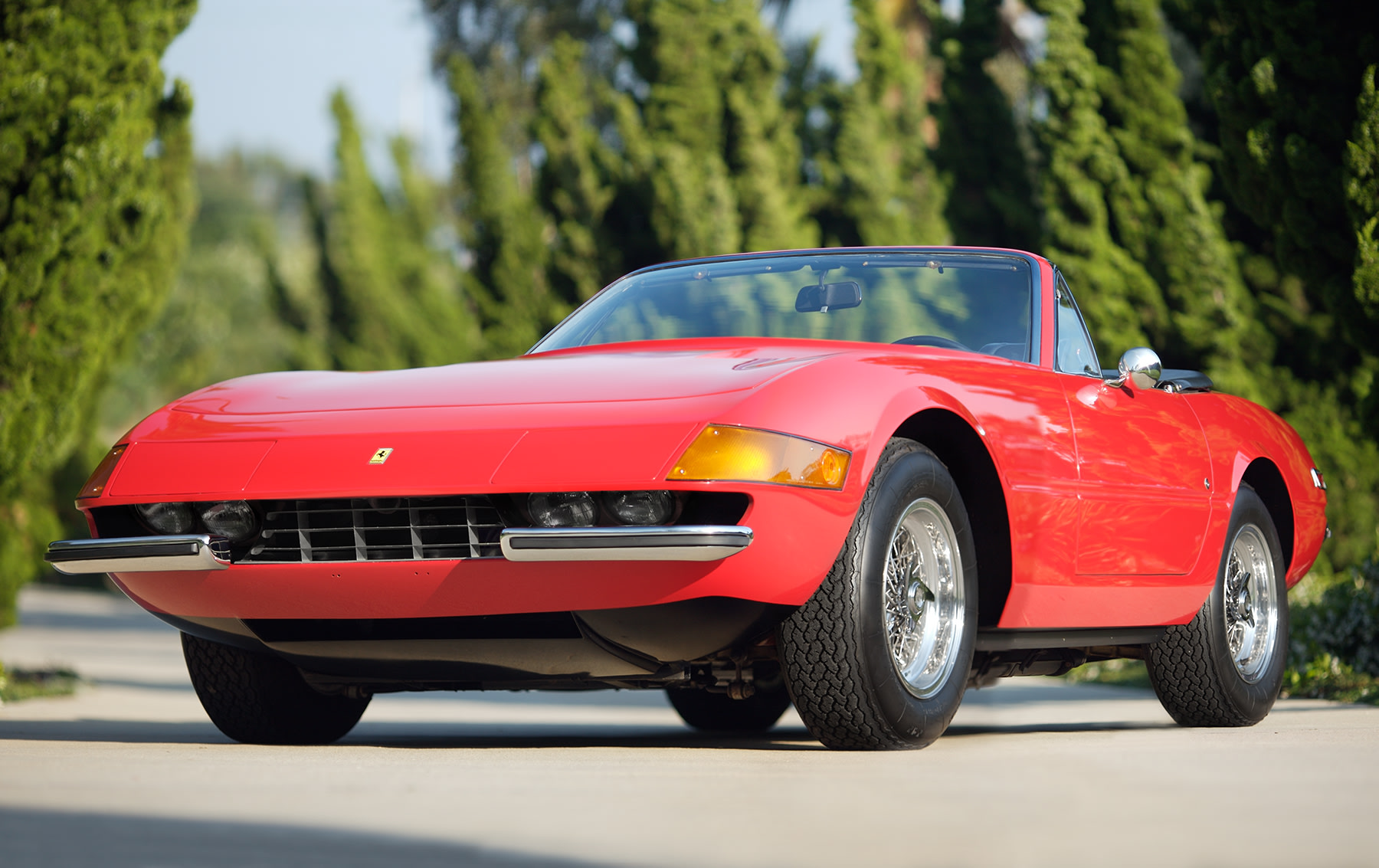
Unveiled at the 1968 Paris Motor Show, the Ferrari 365 GTB/4 — the Daytona — was Ferrari’s response to the Miura. The Spyder, of which only 122 factory examples were produced, takes the Daytona’s 4.4-litre quad-cam V12 producing 352 bhp and removes the roof. Road & Track tested the Spyder at 172 mph in 1972 — a confirmed figure, not a manufacturer claim. The Daytona’s 0–60 sprint ran in the low five-second range, making it the fastest production car in the world at the time of its introduction. It was the last great front-engined Ferrari supercar before the mid-engine layout became the only serious answer — and the Spyder is, by any measure, the most desirable expression of it. Factory Spyders command a significant premium over the coupé and should not be confused with the many post-factory conversions produced by private firms.
- Aston Martin Heritage Trust — DB5 production records and specification documentation
- Ferrari Classiche — 250 GT Lusso and 365 GTB/4 factory records
- Maserati historical archive — Ghibli production figures and pricing
- Lamborghini museum — 400 GT and Miura specification sheets
- Jaguar Daimler Heritage Trust — E-Type Series 1 production data
- Toyota Corporate History — 2000GT development records
- Mercedes-Benz Classic — 300SL Roadster documentation
- Road & Track — Ferrari 365 GTS/4 road test, 1972
The Gentleman Who Wants
the Full Picture
Every MGA Motoring feature, road history, and collector guide. Inside MGA Premium.
Become an MGA Premium MemberEditorial commentary reflects the independent analysis of Modern Gentleman Archive. All factual reporting is drawn from cited third-party sources. MGA makes no claim of ownership over source material. Images used for editorial commentary purposes; credits as captioned.