
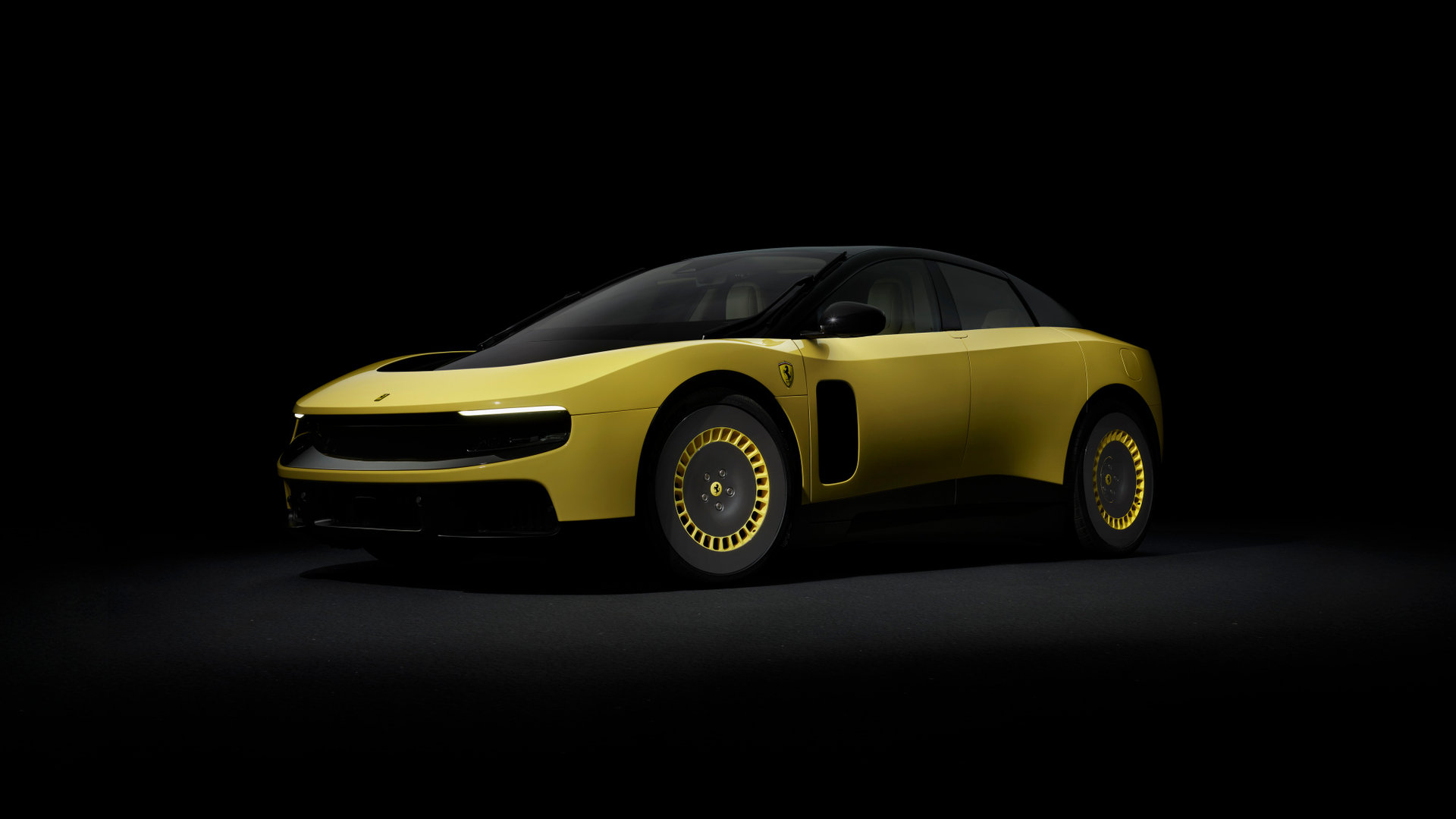
Ferrari has made beautiful things and ugly things and occasionally things so strange that beauty stopped being the right category. The Luce belongs to the third group.
Unveiled in Rome on the evening of May 25, Ferrari’s first fully electric car arrived wearing a body that nobody — not the journalists, not the investors, not Luca di Montezemolo, who ran Ferrari for twenty-three years — was quite prepared for. A five-seat, four-door machine with a tall glasshouse, smooth unbroken surfaces, and proportions closer to a Scandinavian design exercise than anything that has ever left Maranello. Priced at $640,000, it carries four electric motors producing 1,036 horsepower and 730 lb-ft of torque, transmitted to all four wheels through a dedicated 880-volt platform that Ferrari built from nothing for this car alone. The claimed 0–60 time is 2.4 seconds. Top speed is 193 mph. Range on a full charge is 329 miles — recovered, under ideal conditions, in roughly twenty minutes via 350kW DC fast charging. The weight, at 4,982 pounds, is the number that tells the most honest story about what the Luce actually is.
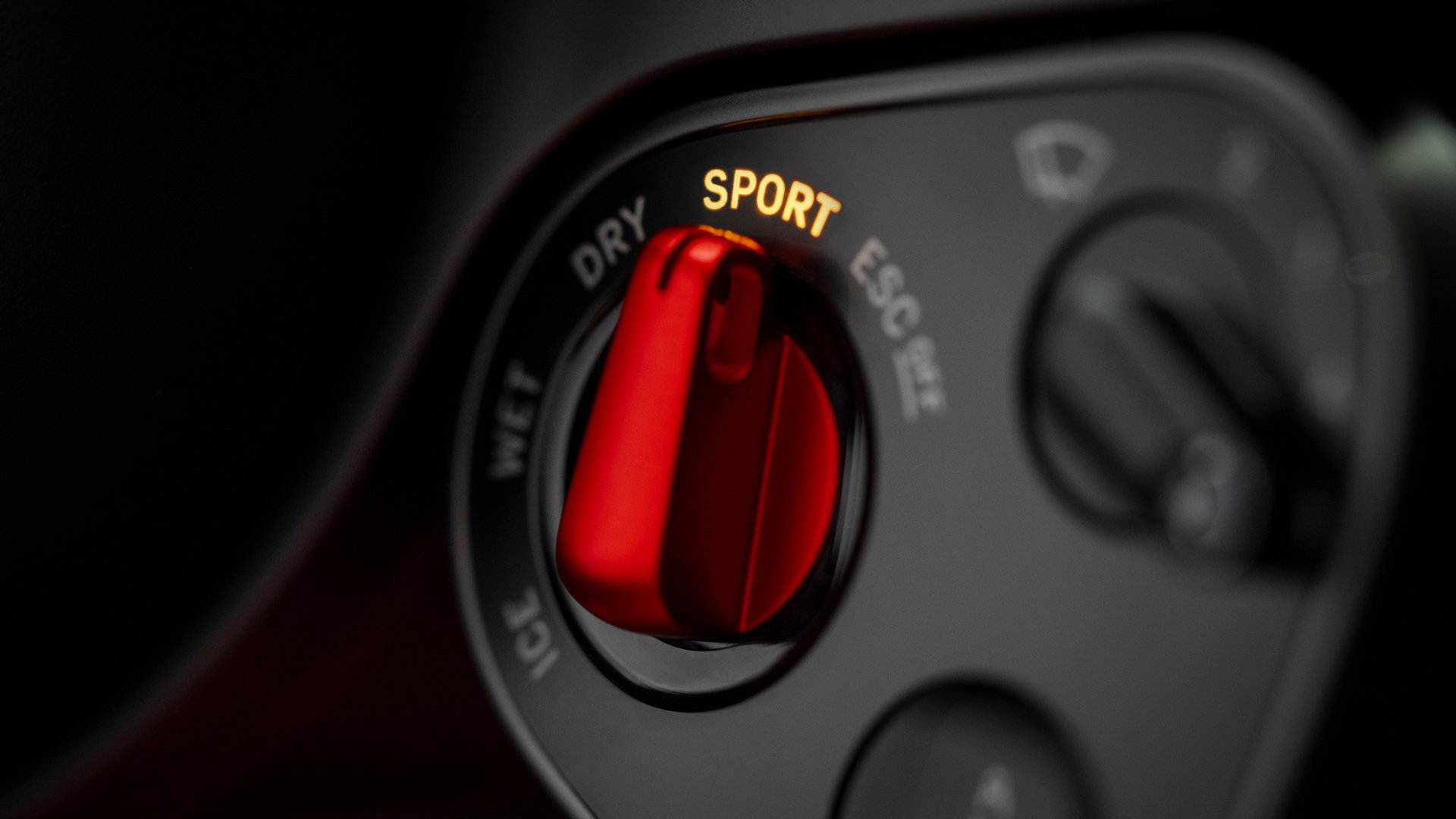
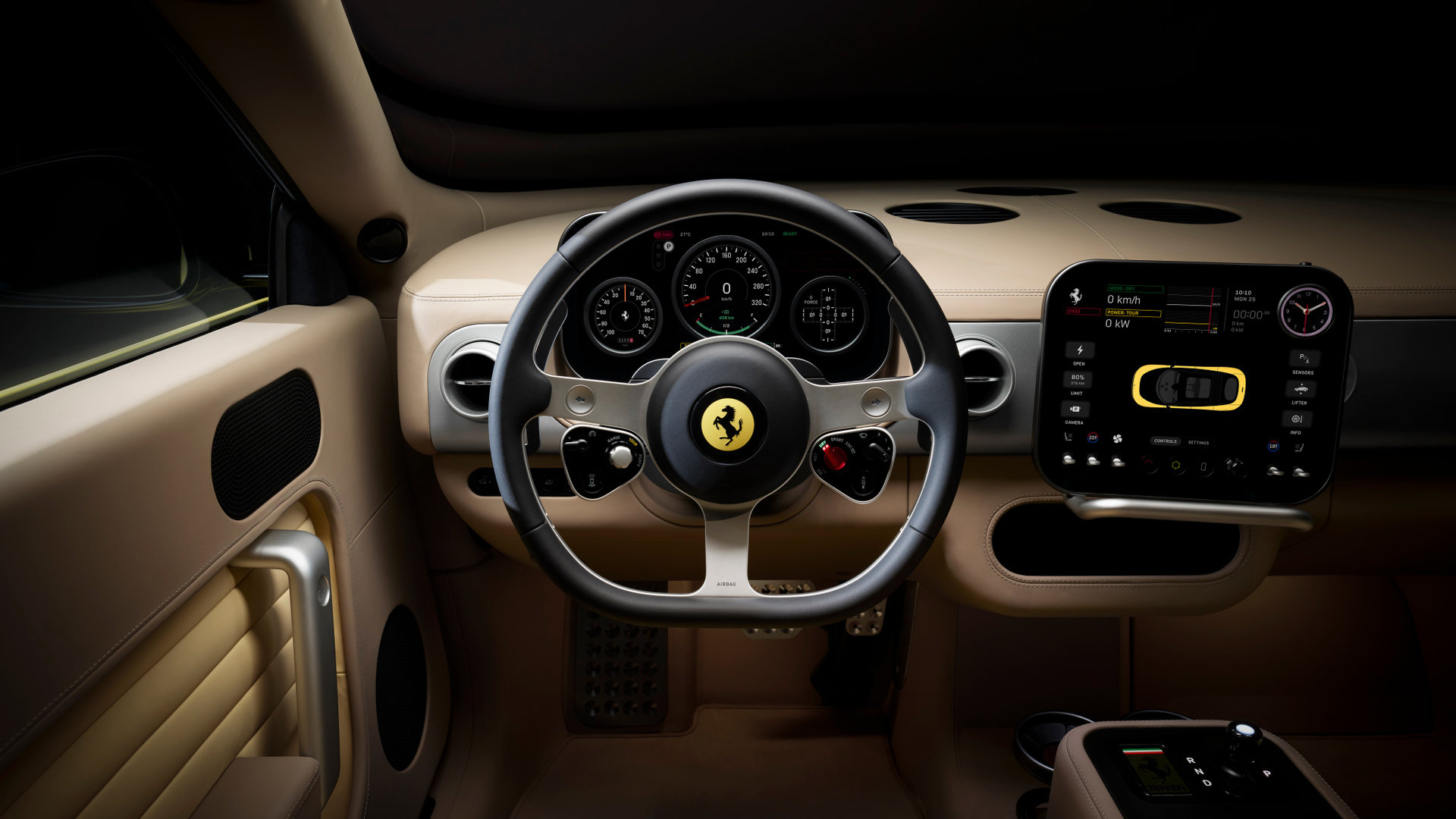
The interior came from two places simultaneously. Flavio Manzoni, Ferrari’s chief designer, led the exterior. The cabin was the work of Jony Ive and Marc Newson at LoveFrom. The result commits fully to physical controls: precision-machined dials, toggles, and switches in anodised aluminium and glass, layered OLED panels with physical needles suspended between them, a three-spoke steering wheel machined from recycled aluminium. In an era where every manufacturer is installing the largest touchscreen it can source, Ferrari and Ive went the other direction entirely. Ive’s reasoning was direct: multi-touch belongs on a phone, and a driver should be able to operate a car by feel alone.
That decision is the most defensible thing about the Luce. The rest invites a more honest conversation.
Car Design News called it “a fascinating object and an unconvincing Ferrari” — and the distinction matters. An object can be extraordinary and still fail as a Ferrari, because a Ferrari is not merely an object. It is a specific promise, assembled over seven decades, about what driving feels like when the engineers have been given permission to be unreasonable. The Luce makes a different promise. Ferrari’s CMO described the car as an opportunity to enlarge the Ferrari community — to reach buyers who were never going to buy a 296 or an 812, but who will write a cheque for something that carries the badge and seats five in genuine comfort. That is a legitimate commercial strategy. It is also an acknowledgment that the Luce is a second car for a different kind of buyer.
Manzoni invoked Enzo Ferrari in the press interviews — specifically the line about tradition being the preservation of fire, not the worship of ashes. It is a good line. It also requires the fire to still be recognisable after the transformation. The Purosangue faced similar scepticism at launch and became Ferrari’s strongest seller. Whether the Luce follows that trajectory — production begins in late 2026, with US deliveries in the second quarter of 2027 — is a question that time will settle.
For now, the gentleman’s verdict is this: the interior is the most considered cabin Ferrari has produced in a decade, and Ive was right about the touchscreens. The exterior is a bet on a future that Ferrari believes in and its existing clients largely do not. Both things can be true. But the conversation about what a Ferrari is supposed to feel like — and whether electric power can carry that feeling — has only just begun.